Monday, January 23, 2012

January 23, 2012 - Copperplate Class #2 at Sinai Temple

Today DeAnn had us do calligraphy calisthenics (“calli-sthenics”) and demonstrated writing the Copperplate lowercase alphabet.


To warm-up, DeAnn had us write ovals in the whitespace of the Large guideline using the nib of our choice. She had us place the left hand (or non-writing hand) on the paper pad above where we were writing to “hold” our body so that our right hand (or writing hand) could move freely to make the big strokes. First we made ovals that were clock-wise; then counter-clockwise. Then we wrote the basic strokes at this big size. The Large guideline has slant-lines space ¼” apart. We wrote the basic strokes in every other space.


The larger size magnifies where your mistakes are, so you can work on correcting them. At this size, the basic strokes are distorted, but the idea is to get a sense of even spacing.

PRACTICE:  write LARGE for this whole week. Do some of these exercises.


Review: The pen should be held so that the nib is in line with the slant-lines on the guideline sheet. The slant lines aren’t for spacing, only as guides for the slant. The letters are written on the line with the black rectangle at the beginning. This is the waist-base line. The line above the waist is the ascender, the line below the base is the descender. Strokes  #1 (most of the time), #2, #3, #4,  #7, #8,  and #9 are written between the waist and the base. Stroke #5 goes up to the ascender, stroke #6 goes down to the descender.

Spacing: the goal is for the whitespaces of strokes #2, #3, #4 and #8 to be the same so that your Copperplate looks like picket fence spacing, very even and regular. This will be the basis of flourishing that you’ll learn later. If the picket fence foundation isn’t strong and steady, the flourishing will look weak.


RATIO:  is the Rule of Pointed Pen. In Copperplate, pen width doesn’t determine x-height (height of the letter “x”) like it does for chisel-point nibs. Instead, the ascender and descender length depends on the ratio  and x-height being used. Currently, we’re using the large ¼ - inch guideline sheet. ¼-inch refers to the x-height, the space between the waist and the base. These lines are indicated by the black box on the left margin (i.e. the highlighted areas). The line above the waist is the ascender, the line below the base is the descender. Write 3:2:3 at the bottom of the guideline sheet to indicate the ratio of the spaces between the horizontal lines. 3:2:3 is the same as 1:1.5:1. If the x-height (base to waist space) is considered 2 units of space, then the ascender & descender lengths are 3 units of space. So if the x-height is 1/4” (= 2/8”), then the ascender is 3/8” from the waist and the descender is 3/8” from the base. The 35-degree slant lines are there as guides for the angle of writing, not for spacing.


The ratio of 3 : 2 : 3 is normal.  DeAnn addresses envelopes in this ratio, as this ratio provides better readability. 2 : 1 : 2 is elegant. This ratio leaves more room for flourishing if you’re creating an invitation or writing  a poem. 1 : 1 : 1 is simple. This is like writing in a spiral bound notebook.


Nibs: from now on, practice with all the nibs. If you’re having a nightmare with a particular nib, switch! Note on your Nib Identification Chart your observations of each nib, using the Gillot 404 as the measure for “medium sharp, medium flexible.” For example, you may find the EF 66 nib “very flexible” compared to the Gillot 404. Become familiar enough with your nibs that you can recognize them by sight. For example, the Gillot 404 has a ridge and the Gillot is shorter than the Gillot 1068. Learning your nibs is important because one nib doesn’t work for everything. Depending on the effect you want to achieve, different nibs will be able to do the job. For example, DeAnn prefers the Gillot 1068 or Brause Steno for envelope addressing because those are stiffer, duller nibs.

Lowercase alphabet: Refer to the Exemplar and the Copperplate Stroke Sequence handout. Remember: all the downstrokes should be the same width. All the whitespaces should be the same. DeAnn does pick up her pen with each stroke. The Copperplate exemplar that’s in color contains a lot of information – study the notes DeAnn has written on it.

Notes on individual letters:

a: 7 – 8 – 3.  The entrance stroke #7 goes up 2/3 of the way to the waist. The outer edge  of the #8 stroke doesn’t overlap the #7, but meets it. Then the #3 stroke should not overlap, but just kiss the #8 stroke so the the whitespace of #8 is still oval.


b: 7 – 5 – 3 – 9:  #7 goes up to the waist, then jog over to make the #5 stroke. The downstroke going all the way to the base will cover the jog-over. #9 should come down from the waist to exit at 3:00. If it’s too high, it’ll be difficult to connect to the next letter.


c:  7 – 8 but leave open – dot.

d:  7 – 8 – long 3: stroke #3 starts halfway between the ascender and waist and should just kiss #8.

e:  7 – jog-over & 8: all the #8 strokes should be the same width, so be careful not to make the jog-over too small.

f:  7 – jog-over & long 5 – 9: stroke #5 ends halfway between the base and descender. Start stroke #9 a little above the base-line, then touch the baseline before surving upward.

g:  7 – 8 – 6:  the loop of stroke #6 should cross below the baseline to avoid a dark spot.

h:  7 – jog-over – 5 – 4:  start stroke #4 from the base line, go upward along edge of wet ink. This creates a better connection; you don’t want to start stroke #4 near the waist – this creates an awkward jog from #5’s downstroke.

i:  7 – 3, then dot: the dot on the “i” and “j” is also called a jot or a tittle. The dot should be the same width as the downstroke.

j:  7 – 6, then dot.

k:  special case: 7 – jog-over & 5 – upstroke with terminal dot – modified #3

l:  7 – jog-over & 5 – 3

m:  2 – 2 – 4. For the 2nd #2 stroke and #4, slide up the edge of the wet ink. All the whitespaces should be the same width.

n:  2 – 4. Same as for “m”.

o: 7 – 8 – 9. Start the #9 at about 2:30 so that it comes out at 3:00

p:  7 – long 1 – 4. Stroke #1 should start halfway between the ascender and waist. It should end halfway between the base and descender.

q:  7 – 8 – 6 (backwards loop): the downstroke of #6 should just kiss #8, not overlap. The loop should not touch the downstroke.

r:  special case: 7 – loop – modified #3. The loop is above the waist with no pressure on the upstroke; fill the loop on the downstroke. This is the French “r”. The English “r” is a #2 – loop.

s:   special case: 7 – loop – curvy downsroke with terminal dot – 7. Downstroke starts with little pressure, increase to full pressure for belly of “s”, then no pressure before the terminal dot. Pick up pen to make the final #7 stroke.

t:  7 – long 3 – crossbar. Start stroke #3 halfway between ascender and waist. Crossbar should be slightly longer on the right side.

u:  7 – 3 – 3.

v:  4 – 9. Dot of #9 should be inside #4.

w:  7 – 3 – 3 – 9. Dot of #9 should be inside #4.

x:  special case:  4 with diagonal downstroke – upstroke with initial dot and terminal dot. Alternate x is a #2 that curves in and ends with a dot; then like a c with no pressure

y:  4 – 6 or 7 – 3 – 6. Loop of #6 should cross below the base. Use alternate “y” depending on previous letter.

z:  special case:  2 with loop at end – 6. It’s OK for the #6 loop to go beyond the top half – don’t squish it.

alternate x and alternate y

Mix sepia ink: Vermillion ink with a few drops of Higgins Eternal makes a sepia-colored ink. Fill one of the inkwells about halfway with Vermillion ink, then add 6 drops of black ink from your Higgins Eternal + gum Arabic dropper bottle. Stir with the end of your pen holder. It may not mix right away; wait a day and the color will look more blended. Add less or more black ink for a lighter or darker shade of brown.

HOMEWORK:
1. Practice the letters
2. Try different nibs
3. Label the writing (also label the nib ID chart)
4. Use black & vermillion ink. & sepia
5. Do some of the large-size exercises every time you practice

If you get confused and discouraged, just go back one step and practice the strokes. Practice the letters slowly and carefully and think of all the stroke numbers.  It may be helpful to trace the letters of the exemplar .

Wednesday, January 18, 2012

January 9, 2012 - Copperplate Class #1 at Sinai Temple

(note: more photos to come)
DeAnn introduced herself and had the students introduce themselves.

DeAnn’s Philosophy for learning Copperplate: For success in writing beautiful Copperplate, think of the Copperplate letters as a series of STROKES, which you’ll be learning in today’s class. By disassociating them from the letters you’re familiar with, you can avoid common mistakes that could make your Copperplate letters look like cursive writing.

DeAnn distributed supplies and handouts. We will be starting out using the Gillot 404 nib and Vermillion ink, using the large (1/4”) guideline sheet. The Gillot 404 nib has a ridge that distinguishes it from the Gillot 303.


DeAnn strongly recommends “Let’s be organized this semester”. Find a container to carry your supplies. Study your handout and put it in a folder or binder that will help you find the appropriate page quickly. A lot of information is in the handouts, so even if you miss something DeAnn says in class, reading the handout later will be very helpful.

Preparing your supplies for ease of transportation: pour ink from their containers into the dropper bottles. The dropper bottles are leak-proof so bring those to class; it’s OK to leave the original containers of ink at home. From the dropper bottles, fill one of the ink wells (or “dinky dip”) to at least the ridge-line. You want to be able to dip your pen and cover the nib’s reservoir area (“eye of the needle”) completely.


Learn Your Nibs: Unlike calligraphy written with a chisel-point nib, Copperplate nibs create thicks & thins by pressing & releasing. The more pressure you apply when pressing on a down stroke, the wider the stroke. So unlike chisel-point nibs that come in different set widths (e.g. 5mm, 1mm), Copperplate nibs come in a wide variety of sharpness and flexibility. This is another important area to explore & learn. By the end of this semester, you will have filled out your nib chart with notes on each of the nibs, paying particular attention to each nib’s sharpness and flexibility.
Satomi's nib chart

Preparing the Pen: Put the nib into the oblique pen holder so that the “eye of the needle” (the opening in the nib) points directly upward. The fit may feel tight, but push the nib in at least halfway for a secure hold. Hold the oblique holder as you would normally hold your pen, with the angled nib to the left side. If you have a brand new nib, you’ll need to prepare it by rubbing gum Arabic all around so that the ink will adhere to the nib and not just bead-up and slide off. New nibs usually have a waxy coating and you may have to rub with gum Arabic several times until the ink will stay in the reservoir. NOTE: Vermillion ink will rust your nib, so wash it off with water after you’re done practicing.

Preparing the paper: Make a crease in the cover of the cotton comp paper pad about an inch down from the top. Fold this back so that you’ll have a flat writing surface without the cover bunching up to the left. Place the guideline sheet underneath the first sheet.

Guideline sheet: We’ll be starting with the large ¼ - inch guideline sheet. ¼-inch refers to the x-height, the space between the waist and the base. These lines are indicated by the black box on the left margin. The line above the waist is the ascender, the line below the base is the descender. 3:2:3 at the bottom of the guideline sheet refers to the ratio of the spaces between the horizontal lines. 3:2:3 is the same as 1:1.5:1. If the x-height (base to waist space) is considered 2 units of space, then the ascender & descender lengths are 3 units of space. The 35-degree slant lines are there as guides for the angle of writing, not for spacing.


TIP: DeAnn suggests highlighting the waist to base space so that it’s easier to distinguish as the line to write on underneath the cotton comp sheet. The handouts are already highlighted, but remember this tip for guideline sheets you later create yourself.

Prepare your work space: The key to being able to write Copperplate correctly is to set up your work space correctly and sit in the right position in relation to your paper. Position the paper so that the slant lines are pointing toward your stomach. This angle may seem extreme, with the paper pad almost at right angles to the table’s edge, so you need to position yourself so that your elbow rests completely on the tabletop, which means you’ll probably have to sit at an angle to the table edge so you’re not twisting your torso.


Use your left arm to take the weight off your body by placing your left hand above the area where you’re writing. Try to learn NOT to have a heavy writing hand, but practice having a light touch. Putting the pressure on your left hand helps with this. REMEMBER to breathe! If you’re having trouble writing the strokes, exhale.

Writing with the nib:
1. Write straight lines (with slant)
2. Pen should be in the direction of the slant lines
3. To create the square top & bottom edges, set – press – pull – stop – release
4. If the nib is sticking into the paper, adjust the angle of how you’re holding the nib. Lowering the angle may help.

Writing the basic strokes: You apply pressure on the down stroke (thick), no pressure on the up stroke (thin). This is how you create thicks & thins. The goal is for all the down strokes to have the same width (i.e. consistent pressure). Look carefully at the exemplar handout, it has a lot of important information on it.
the basic Copperplate strokes

Notes on individual strokes:
1. #2, #3, #4, #8 should all have the same white space. White space is the space between the down strokes & the up strokes.

2. #2, #3, #4: the arch should be like a paperclip.

3. #2, #4: start the curve with no pressure, build up to full pressure by midpoint on the down stroke.

4. #4: start the second curve before you hit the baseline so you don’t have a “staple” instead of a paperclip curve.
5. #5, #6: the size of their white space should be similar, though they are not exactly the same shape.

6. #8: start at 3:00 and think of it as an oval shape, more hot dog than hamburger. It’s thickest through the center. The inner white space should match the width of #2, #3, #4 strokes.

7. #9: start counterclockwise to create a tiny filled oval, then exit. Like the #7, it’s an exit stroke to the next letter.

REMEMBER: Don’t get overwhelmed! If you get really anxious, go back to the last step you were comfortable with and practice that. You can even practice the Copperplate strokes with a pencil if it all seems to be too much at the moment.

HOMEWORK: Practice all the strokes with the Vermillion ink and Gillot 404 nib. Study the exemplar carefully – it is more important to be accurate than to write a stroke many times. Memorize the basic stroke numbers – DeAnn will test you next week. Then try out all your other nibs and see how they’re different from the Gillot 404. Be sure to note on your nib chart that the Gillot 404 is “medium sharp, medium flexible”. Observe how the different nibs behave in comparison to the Gillot 404 (e.g. “very sharp”, “dull”, “very flexible”, “stiff”).

NOTE: On your practice sheets, write what nib you used, ink type, and then date in the lower right corner. Also put your name in the lower right corner on practice sheets you turn in for homework. DeAnn will review and give a thorough critique.

NOTE: The Gillot 1068 nib is made of thinner metal than the others so it may be loose in your pen holder. Flatten it slightly (be careful not to flatten it too much!) just at the very end (NOT the tip!) with small needle-nose pliers.


If the ink doesn’t come out from the nib point, go back and forth slightly to start the ink flowing. Wet attracts wet, so if you can get a spot of ink to start the stroke, the ink should flow more smoothly.

REMINDER: No class next Monday, 1/16/12, due to Martin Luther King, Jr. Day. Class will resume on 1/23/12. Also, no class on 2/20/12 due to Presidents Day.

November 28, 2011 - Pointed Pen Variations Last Class (#8) at Sinai Temple

(note: photos to come)
Today DeAnn talked about flourishing letters.

Homework observations:  the “o” loops at the side, not at the top. The “a” doesn’t touch at the stem. End a letter low to make a good transition to the next letter. Really look at the letter forms on the exemplar.

Great idea from Caroline:  once you have written out your project poem “plainly” (i.e. without flourishes) and have a finished piece, copy it several times. Then experiment with flourishing and decorations on the copies until you’re satisfied. Create your final flourished piece using your sample.

Connections:

Homework by Sabina:

Review:  the three elements of flourishing are circle, oval, and figure 8.

Key word to remember: BIG
Leave off small flourishes altogether.
If the nib is very sharp, it’s harder to do flourishing.

DeAnn’s advice:  Flourish your heart out; then when it seems ridiculous, scale back.
Mix it up – don’t use the same flourish each time for a letter. See what the context is.
Finish every stroke:  does it pull your eye back into the letter? Don’t let it flop outward and send your eye into space.

You can cross strokes over during flourishing, but 2 thick strokes can’t cross (it creates a dark spot).
Thin + thin = OK
Thick + thin = OK
Thick + thick = NO

Think about the readability of the purpose; e.g. an address on an envelope vs. a wedding invitation.

Saturday, November 26, 2011

November 21, 2011 - Pointed Pen Variations Class #7 at Sinai Temple

(more photos to come)
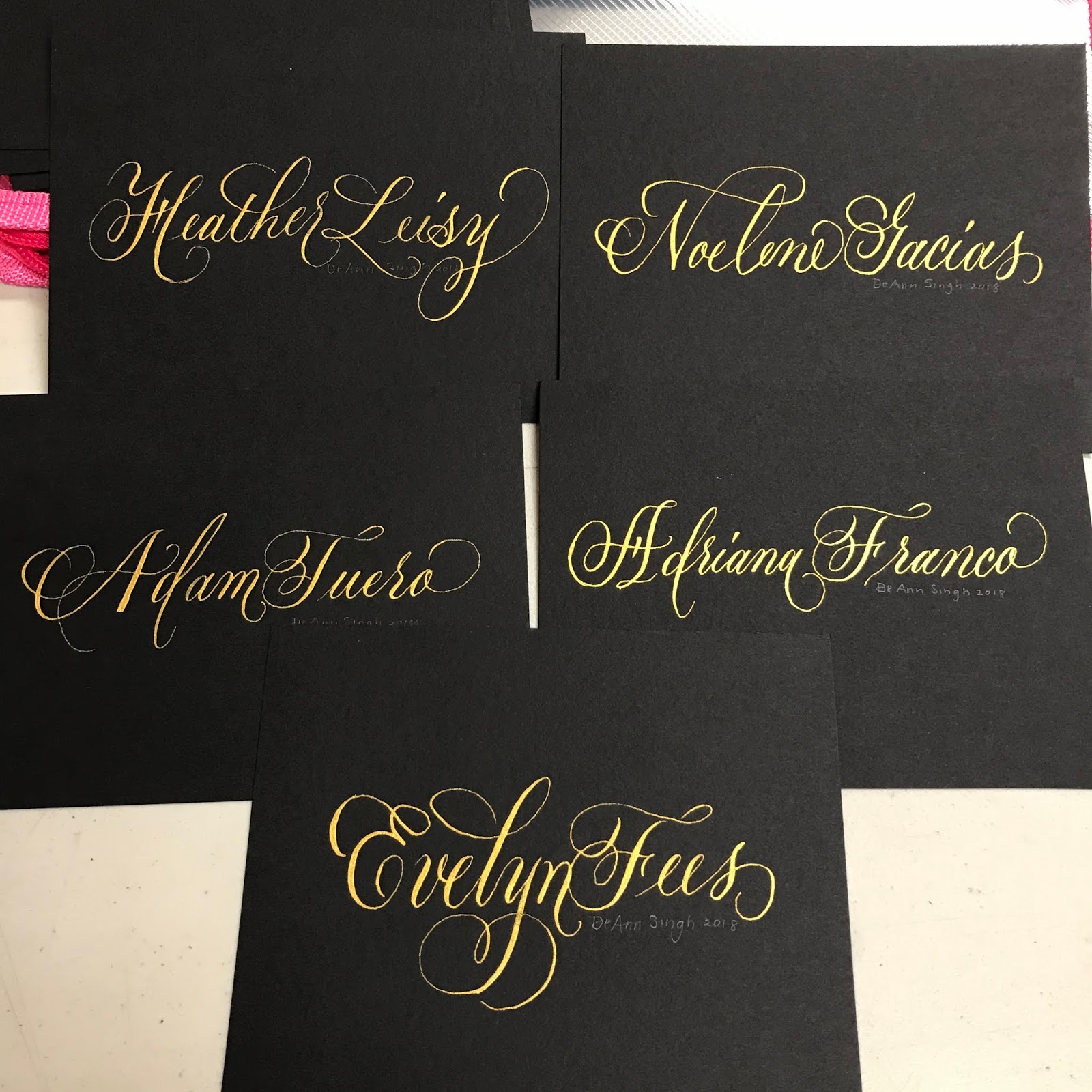
Today DeAnn talked about flourishing. The handouts were 2 sheets that Satomi Wada made for us on flourishing.

Flourishing handout #1 by Satomi Wada
Flourishing handout #2 by Satomi Wada

DeAnn also had us practice until we were “in the zone.” Then later, she had several students write while others observed them.

Class Gallery
Homework by Satomi:
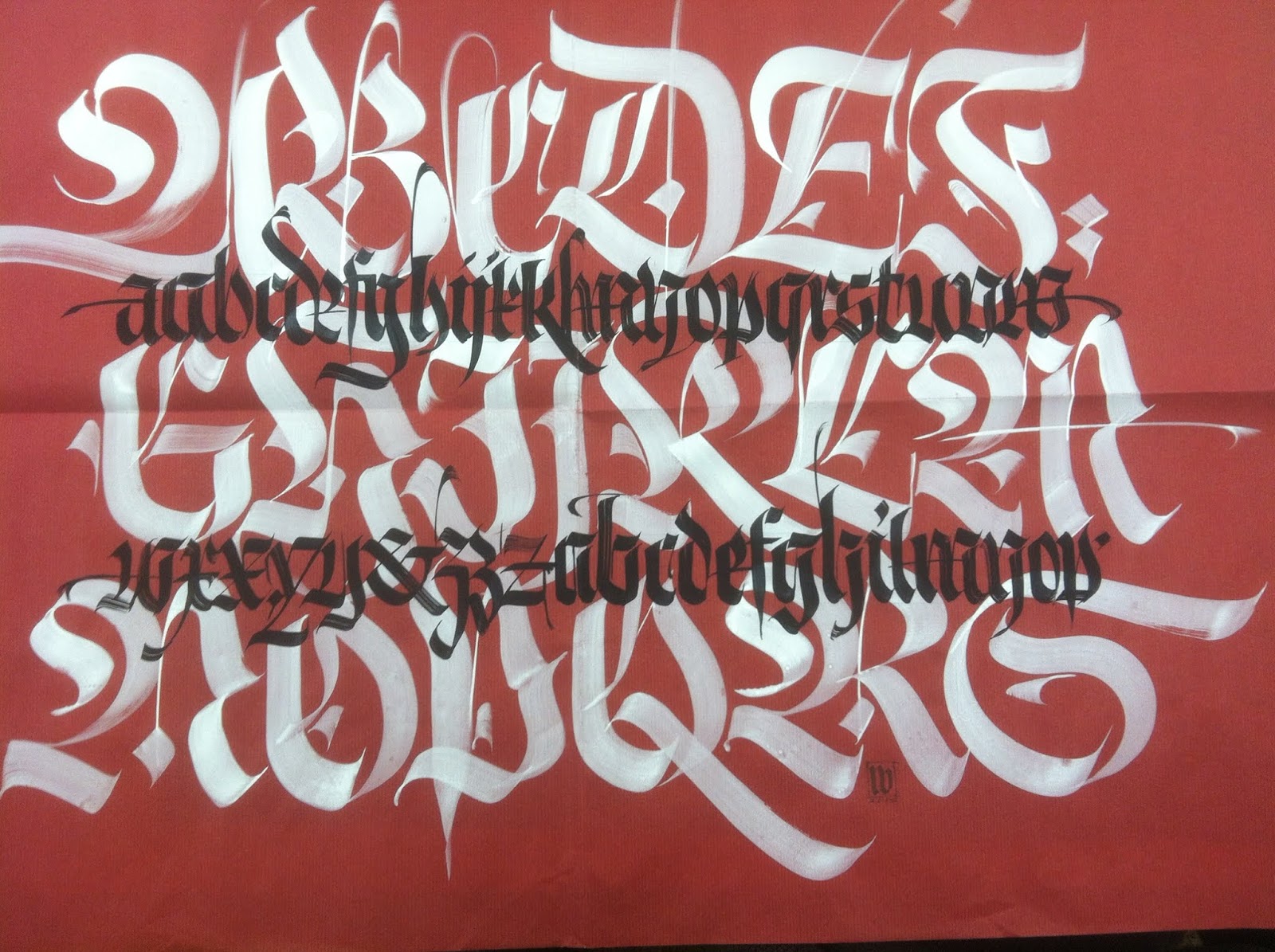
The ink is Permanent White Gouache on red paper


Homework by Sabina:
The ink is white pearlescent.

Sabina drew the baselines free-hand, then measured the waistlines.

Homework by Judith:


Great sampler idea from Brianna:  Brianna wrote detailed notes on each of the nibs she tried on the different papers.
See detailed notes of her observations for each nib.


Flourishing: the three elements of flourishing are circle, oval, and figure 8.

Downstrokes with no pressure.

No pressure – pressure – no pressure strokes:  A fun exercise is to draw a square or rectangle in pencil, then fill it in with these strokes close together, alternating where the pressure areas are, to make a pattern.

Figure 8:  in your mind, extend the lines to complete the figure 8 shape. Don’t let the ends point off into space.

Spirals:  made from ovals. Practice getting them even. Horizontal, clockwise and counter-clockwise. Vertical, clockwise and counterclockwise. No overlap and overlapping.

Direction change:  small loop and full stop.

Draw a diamond shape lightly in pencil to fill in with the figure 8s to help you keep control of the size.


HOMEWORK:  Practice the flourishes from Satomi’s handout. Practice writing out your poem and adding some flourishes.  Next week is the final class.